Baton Rouge Sewer Fees: Why Bills Don’t Match Current Water Use
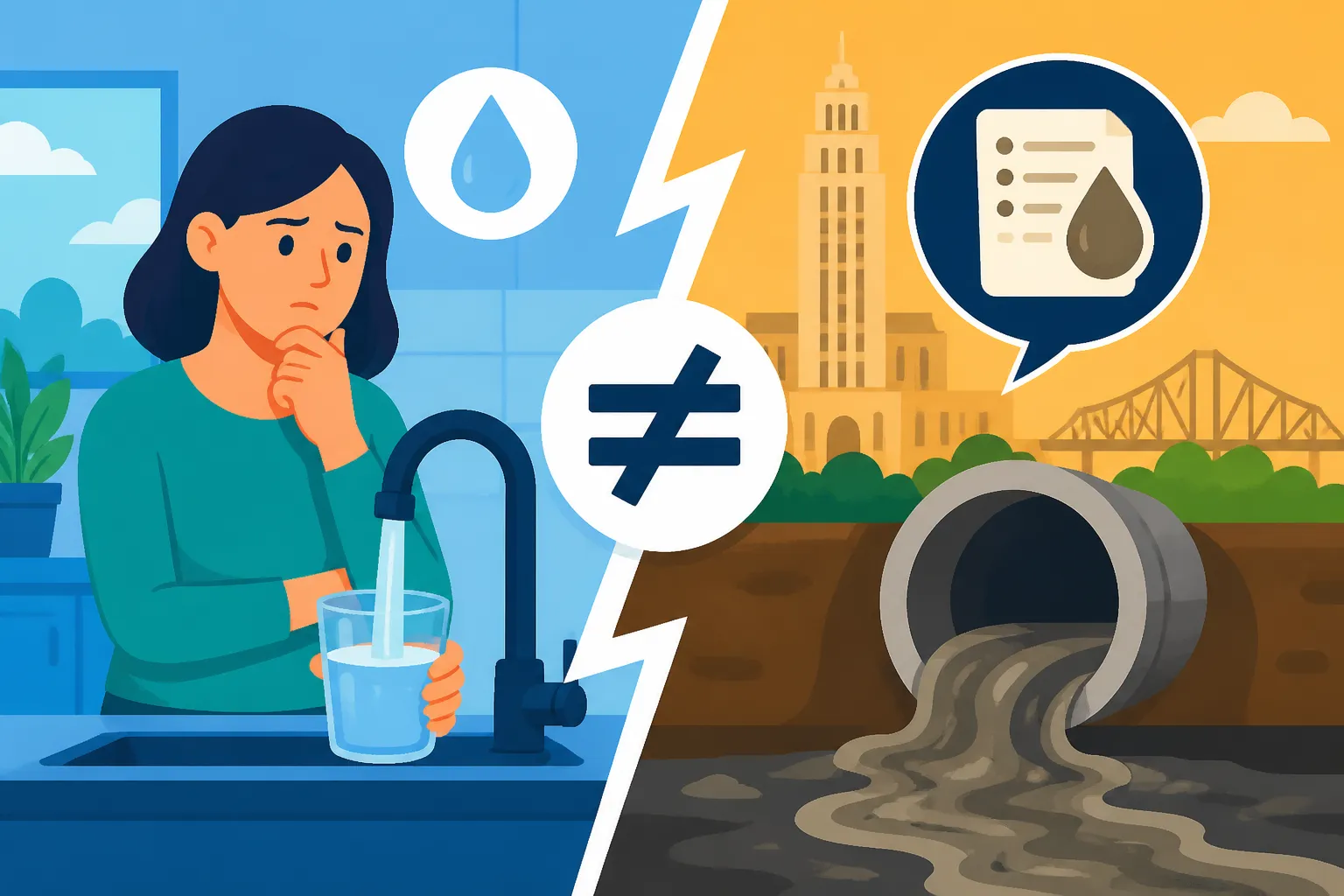
A Baton Rouge sewer charge can seem disconnected from the water use shown on the same bill. The reason is timing: the charge is based on water consumption from an earlier set of months, not simply the current reading. Knowing which months count can help you understand the amount, compare it with your records, and decide whether to request a review.
Why the sewer charge can differ from this month’s water use
A water bill reports water use over a particular billing period. The sewer charge, however, may be calculated using a different period. That means a change in this month’s water use does not necessarily produce an immediate change in the sewer amount.
According to the City of Baton Rouge / East Baton Rouge Parish, Baton Rouge recalculates the sewer charge each July using average water consumption during the months of October, November, and December of the prior year, plus February, March, and April of the current year. The calculation does not use the water use on this month’s bill.
That timing is the key to understanding a mismatch. If your current bill shows lower water use than a bill from the months used in the calculation, the sewer charge may still reflect the earlier average. If current use is higher, the sewer charge may likewise not reflect that increase right away. The difference does not, by itself, show that the current water reading or sewer calculation is wrong.
The calculation period also skips January. It is made up of months from the end of the prior year and the start of the current year, rather than one continuous stretch. When comparing records, it is important to use the months specified for the calculation, not simply the latest sequence of bills.
| What you are comparing | What it tells you | Why it may not match |
|---|---|---|
| Water use on this month’s bill | Consumption for the current billing period | The sewer charge is not based on this month’s use |
| Water use in the months used for the calculation | The consumption history relevant to the sewer charge | It may be higher or lower than current use |
| The sewer charge after the July recalculation | The charge based on the applicable average | It reflects the calculation period, not necessarily a recent change in household use |
For a deeper look at the local calculation, see How East Baton Rouge Calculates Residential Sewer Charges. If you are trying to understand a wider bill change, Baton Rouge Sewer Fees: Why Bills Don’t Match Current Water Use is the broader topic covered here.
Which water-use months matter
The calculation uses two groups of months:
- October, November, and December of the prior year
- February, March, and April of the current year
The City of Baton Rouge / East Baton Rouge Parish says the sewer charge is recalculated each July using average water consumption from those months. Since the listed periods do not include January, adding up every bill from October through April may not produce the same comparison the calculation uses. January is outside the stated set of months.
A practical first step is to gather the water bills or meter records for the months included in the calculation. Compare those records with the amount of use currently being used to calculate the charge, if that information is available on your bill or from the City. The current month’s water use can provide context about what is happening now, but it is not a substitute for the earlier consumption period.
If your bills do not line up neatly with calendar months, avoid assuming that a bill’s issue date is the same as its water-use period. Look for the dates or service period shown on the bill. If the service periods make it unclear which readings fall into the months the City uses, ask the City of Baton Rouge / East Baton Rouge Parish to clarify which records apply.
It can also help to distinguish three things that may appear together on a bill:
- The water-use reading or amount for a particular service period
- The sewer charge currently being billed
- The period or average used to calculate that sewer charge
These are related, but they are not necessarily based on identical periods. Treating them as though they should match line for line can make an otherwise explainable difference look like a billing error.
Keep copies of the relevant bills and note the service dates, water use, and sewer charge. If you need to ask for clarification or a review, having the records together makes it easier to describe the question clearly. You do not need to infer the calculation from a single recent bill when the underlying months are earlier.
Common reasons the amounts look out of step
A mismatch can arise simply because the sewer calculation uses past water consumption while the water line shows more recent use. Household habits and conditions can change between those periods. A household may use less water now than it did during the months included in the average, or the reverse may be true.
A change in occupancy, time spent at home, outdoor use, or a leak could affect consumption in one period but not another. These are possible explanations to check, not proof of what caused a particular sewer charge. The calculation’s timing remains important even if a change in household use explains why the current reading differs from the older records.
A water-use increase that has already ended may also remain relevant if it occurred during a month included in the calculation. Conversely, a recent reduction may not yet be reflected in the charge. Because the City recalculates the sewer charge each July, the timing of a change relative to the specified consumption months matters.
If you suspect a leak or another source of unusually high water use, look at the water-use history rather than relying only on the sewer amount. A higher reading in one of the months used for the calculation could affect the average. If the issue is a leak, locating and addressing it may help with future water use, but it does not establish that the existing sewer charge will be changed. For more on how hidden water use can affect a sewer calculation, see Summer Sewer Fee Recalculation: What Hidden Leaks Cost Homeowners.
It is also possible for the current water-use line to be low while the sewer charge remains unchanged because the charge is tied to the earlier calculation period. That pattern alone does not show that the City used the wrong records. First establish whether you are comparing the same months and whether the water-use amount currently used for the charge is lower than the applicable earlier average.
The reverse situation can be confusing too. If current water use rises but the sewer charge does not immediately rise in step, that does not necessarily mean the charge is missing an adjustment. The current month is not the usage period identified for the calculation. Check the applicable months and the timing of the July recalculation before drawing conclusions.
How to check your bill and decide whether to ask for a review
A careful comparison can help separate a timing difference from a question about the records or calculation. Use the following steps:
-
Find the water service period on your bill. Note the dates covered by the water-use reading. Do not assume that the date the bill arrived identifies the period measured.
-
Identify the sewer charge. If the bill lists water and sewer separately, record the sewer amount and any description of how it is calculated. If the wording is unclear, ask the City of Baton Rouge / East Baton Rouge Parish what the line means.
-
Gather the records for the calculation months. Locate water-use information for October, November, and December of the prior year, and February, March, and April of the current year. Keep January separate because it is not included in the months stated for the calculation.
-
Compare the relevant average with current use. The City’s review condition refers to the latest six-month average being lower than the usage currently used to calculate the charge. If you cannot tell what usage is currently being used, ask the City to explain the comparison before deciding whether the condition applies.
-
Request clarification or a review if the comparison supports it. According to the City of Baton Rouge / East Baton Rouge Parish, existing residential customers can request a review if their latest six-month average is lower than the usage currently used to calculate the charge.
This distinction matters: the fact that this month’s water use is lower than the sewer charge’s underlying usage is not necessarily the same as showing that the latest six-month average is lower than the usage currently used to calculate the charge. Check the stated comparison rather than relying on one recent bill.
When contacting the City, describe the issue in terms of the relevant records. For example, explain that you are trying to understand which water-use average is being used and whether your latest six-month average is lower. Include the service periods and readings you have, and ask what additional information is needed for a review. The available information does not specify what documents the City requires, how a review is submitted, or what outcome follows, so confirm those details with the City’s official website.
A review request is a way to have the comparison checked; it is not a promise that the charge will change. The City’s stated condition is about whether the latest six-month average is lower than the usage currently used to calculate the charge. If the figures do not meet that condition, or if the records are incomplete, ask for an explanation of the calculation before assuming an adjustment is available.
If the records appear inconsistent, focus your question on the specific discrepancy. Check whether the usage belongs to the correct service period, whether one of the listed months is missing, and whether you are comparing a monthly reading with an average. A difference in formats or periods can make two valid figures appear contradictory.
What to do when the comparison still does not make sense
If you have gathered the records and still cannot follow the calculation, ask the City of Baton Rouge / East Baton Rouge Parish to identify the usage figure currently used for your sewer charge and explain how it relates to the listed months. Ask whether the figure is an average and which service periods were included. This keeps the conversation focused on the inputs instead of only the amount due.
If a water-use record appears unusually high, check the meter reading and service dates shown on the bill against your own records, where available. A sudden change may reflect actual use, a leak, a reading or billing-period difference, or another issue that needs clarification. Do not assume that a high water reading is automatically a sewer calculation error; the two questions may need to be checked separately.
If the readings look correct but the sewer calculation still seems inconsistent, ask whether the usage currently used to calculate the charge is the same figure shown in your records. If the City identifies a different period or average, ask for the period and the records behind it. Keep notes of the explanation so you can compare it with the next bill or any review response.
For existing residential customers, the stated review option is tied to a specific comparison: the latest six-month average must be lower than the usage currently used to calculate the charge. If you believe that applies, ask the City how to request the review and what records to provide. Use the official City of Baton Rouge / East Baton Rouge Parish website for current instructions and contact details.
If you rent or share responsibility for a water account, check the account arrangement and any lease or household agreements before deciding who should raise the billing question. The City’s stated review information applies to existing residential customers; it does not specify how account responsibility is handled in every living arrangement. Confirm the account details with the City and review any relevant lease or agreement.
Finally, avoid treating a sewer charge as a real-time measurement of what left the property through the drains. The charge described here is tied to a water-consumption calculation period. That timing helps explain why it may not track the water use on a current bill, but questions about the particular account still need to be checked against its records.
Frequently Asked Questions
Why is my sewer charge different from this month’s water use?
The City of Baton Rouge / East Baton Rouge Parish says the sewer charge is recalculated each July using average water consumption from October, November, and December of the prior year, plus February, March, and April of the current year. It is not based on this month’s water use.
Does January count in the calculation?
January is not among the months specified for the calculation. The listed periods are October, November, and December of the prior year, plus February, March, and April of the current year.
Can an existing residential customer request a review?
The City says existing residential customers can request a review if their latest six-month average is lower than the usage currently used to calculate the charge. Confirm the current request process and any documentation requirements with the City.
Does a lower current water reading guarantee a lower sewer charge?
No. A low reading on this month’s bill is not the same comparison as a lower latest six-month average. The charge is based on the specified prior usage periods, and a review request does not guarantee a change.
Sources
- City of Baton Rouge / East Baton Rouge Parish — FAQs – Finance – Sewer & Garbage User Fees (checked November 14, 2026)
Disclaimer
This article is for general informational purposes only and does not constitute professional advice. Laws, prices and regulations vary by location and change over time. Consult a qualified professional for guidance on your specific situation. Louisiana Water Guide is not a government agency or water utility and is not affiliated with any public water system.