Where Louisiana Tap Water Comes From: River, Lake, or Aquifer
Louisiana tap water can begin in a river, lake or reservoir, or underground in an aquifer. The source depends on the water system serving your address, so a statewide answer won’t tell you what reaches your faucet. Here’s how those sources differ, how utilities treat them, and how to identify your own supply.
Louisiana tap water can come from several kinds of sources
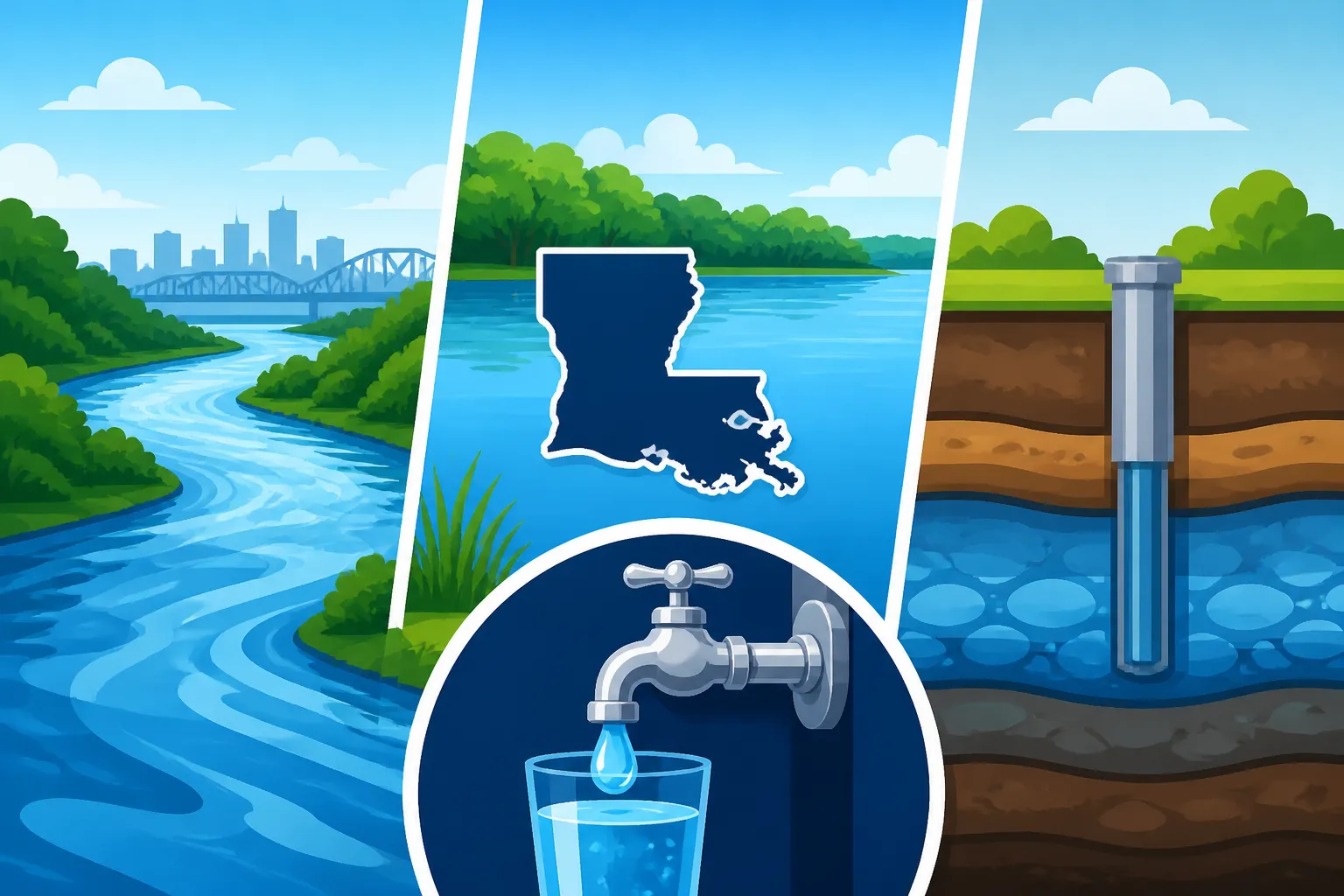
Public water systems in Louisiana draw from both surface water and groundwater. Surface water includes rivers, lakes and reservoirs; groundwater is pumped from underground water-bearing formations called aquifers. Some systems rely mainly on one source, while others can use more than one, depending on their infrastructure and operating needs.
There isn’t one source for all Louisiana residents. A home supplied by a public utility may receive water drawn from a river or reservoir, while a nearby home may be served by a different system that pumps groundwater. People who rely on private wells generally draw groundwater from the formation beneath their property.
The source is the beginning of the water supply chain, not the tap itself. Before public water reaches a customer, the system may treat it, store it and move it through a network of pipes. Water can also encounter building plumbing before coming out of a faucet. That is why a source description alone cannot tell you everything about the quality of water at home.
| Source type | Where the water is found | Common treatment considerations | What it does not tell you |
|---|---|---|---|
| River | A flowing surface-water body | Treatment must address particles and other contaminants that can vary with conditions in the watershed | Whether every contaminant is present, or how water tests at a particular faucet |
| Lake or reservoir | A natural lake or an impounded water body | Treatment depends on the source and can account for changes such as suspended material or seasonal conditions | Whether the water is untreated, or whether a particular home has a quality problem |
| Aquifer | Water stored underground in permeable rock or sediment | Treatment depends on the water’s chemistry and may include steps for naturally occurring minerals or other source-specific concerns | Whether private well water is tested or managed by a public utility |
| Mixed or changing sources | More than one source or a different source under some operating conditions | The system adjusts its treatment and operations to the water it is using | Which source is supplying a specific tap at a particular moment |
Rivers and lakes can be affected by conditions across a broad watershed, including runoff and changes in water levels. Aquifers can have different mineral content and water chemistry from one location to another. Neither source type is automatically safe or unsafe simply because it is a river, lake or well.
To understand the full path from source to tap, start with Louisiana Tap Water Guide: Quality, Testing, and Home Safety. For a broader explanation of source types and how they affect treatment, see Lakes, Rivers, and Deep Wells: How Source Waters Shape Tap Quality.
River water, lake water and reservoir water
Surface water is water found above ground. Louisiana’s rivers include large and smaller waterways, and public systems may draw from a river or from a reservoir associated with a river. A reservoir is a body of stored surface water, often created or managed to serve several purposes. A lake may be natural or managed, and the fact that a utility uses a lake or reservoir does not mean the water is untreated.
Surface-water sources can collect water from a large drainage area. Rainfall and runoff move through that landscape toward streams, rivers, lakes and reservoirs. As a result, the amount of water and its characteristics can change with weather, watershed conditions and the season. The utility’s treatment process is designed around the source it uses and the requirements that apply to its water system.
Why a river may be a source
A river is continually moving, but its flow and quality are not constant. Rain, drought, upstream activity and other watershed conditions can affect the water that reaches an intake. The utility must account for the raw water—the water before treatment—when operating its treatment plant.
Louisiana has several prominent rivers, including the Mississippi, Red, Ouachita, Sabine and Atchafalaya. Naming a river does not establish that a particular community takes its drinking water from it. The source for any home depends on the public water system serving that address, and a river’s presence nearby is not proof that it supplies the local tap.
Some river-fed systems may need to respond to changes in factors such as sediment or turbidity, a measure of how cloudy water is because of suspended particles. A change in raw-water conditions does not automatically mean finished tap water is unsafe. It means the utility must operate and monitor treatment as required for the source and system.
What is different about lakes and reservoirs?
A lake or reservoir can hold water for a period of time rather than carrying it downstream as a flowing river does. The water can still change with rainfall, runoff, water levels and other conditions. A reservoir may be connected to river flows or may receive water from its surrounding drainage area.
A reservoir’s appearance is not a reliable test of drinking-water safety. Clear-looking water may still require treatment, while cloudy-looking source water may be treated at a plant before distribution. Likewise, a lake’s size or distance from a home does not show whether it is part of that home’s drinking-water supply.
Some source waters experience seasonal changes, such as shifts in algae or organic material. Treatment needs depend on the particular source and the system’s monitoring, not just on whether the source is called a lake or reservoir. For instance, earthy or musty odors can have different causes and do not, by themselves, establish that tap water is unsafe. The article Algae and Seasonal Odors: Why City Tap Water Smells Earthy in Summer explains why some water sources and taps can have seasonal odor changes.
Source-water conditions and utility response
Water systems monitor and treat water to meet applicable requirements. The treatment process may need to handle particles, microorganisms and other characteristics of the source. The steps used depend on the water system’s design and the water it is treating; not every utility uses precisely the same sequence.
Surface-water conditions can also change without a visible change in the finished water at a customer’s tap. Utilities monitor their supplies and treatment operations because customers cannot assess treatment performance by looking at the river or reservoir.
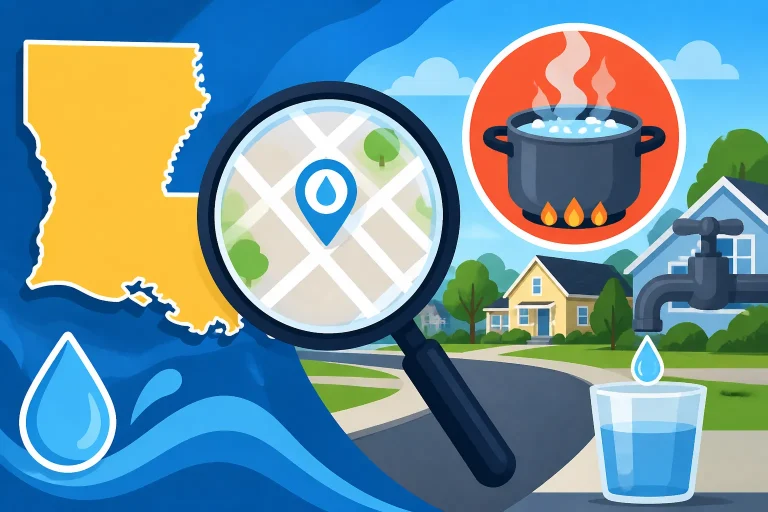
A boil-water advisory is a separate public-health instruction, not a label for a source type. Having a river source does not mean a system is under an advisory, and having a groundwater source does not rule one out. Advisories relate to specific conditions and are communicated by the relevant authorities and water system. For Louisiana-specific background, see Louisiana Boil Water Advisories and Notices: A Homeowner Guide.
Aquifers and groundwater in Louisiana
Groundwater is water held in underground layers of permeable sediment or rock. An aquifer can supply a public water system, an individual household well, or both in a wider area. Groundwater is not necessarily a large underground lake; it usually moves through pores and spaces in geologic materials.
Aquifers vary across Louisiana. The state includes multiple water-bearing formations, and their depth, extent and chemistry differ by region. The Chicot aquifer system in southwestern Louisiana and the Sparta aquifer in parts of northern Louisiana are examples of named groundwater sources. The Mississippi River alluvial aquifer is another major regional formation. These names describe broad geologic resources; they do not identify the source for every home in the surrounding area.
What groundwater can contain naturally
As groundwater moves through sediment and rock, it can dissolve minerals and other naturally occurring substances. That can influence characteristics such as hardness, iron, manganese, salinity or dissolved solids. The particular results depend on the local geology and the well’s construction and depth, among other factors.
This does not mean groundwater is inherently poor quality. Many public systems treat groundwater and monitor it under drinking-water requirements. Nor does it mean every well in a given area has the same chemistry. Nearby wells can have different results because they draw from different depths, formations or conditions.
The word “groundwater” also does not mean “untreated.” Public utilities may treat groundwater before distribution, and a private well owner may need to test and manage the water independently. A system’s treatment process is based on its own source and monitoring, rather than on a general assumption that underground water needs no treatment.
Public groundwater supplies and private wells are different
If a home receives water from a public system, the utility is responsible for operating the system and meeting applicable monitoring and treatment requirements. If a home depends on a private well, the owner is responsible for arranging appropriate testing and upkeep. A private well does not become a regulated public water system simply because it draws from the same aquifer as a nearby utility.
That distinction matters when interpreting test results. A public water system’s report describes monitoring for that system, not the results from an individual private well. Conversely, a private well test applies to the sample collected from that well under the test conditions; it does not establish water quality across the entire aquifer.
If you rely on a well, Louisiana Private Well Testing: What Homeowners Must Know outlines why source-specific testing matters. The article Are Private Wells Covered by Louisiana Drinking Water Standards? explains the difference between public-system oversight and private-well responsibilities.
Groundwater can change, too
It is easy to picture aquifers as protected from surface conditions, but groundwater quality and availability can be affected by local land use, well construction, water withdrawals and changes in the surrounding environment. Coastal and river-adjacent areas may also face salinity-related concerns. These are regional or site-specific issues, not proof that a particular household’s water is affected.
Saltwater intrusion is a particular concern where freshwater and saltwater conditions interact, including some areas with heavy groundwater use or changing river conditions. Whether a municipal supply is affected depends on the system and its source. Could Mississippi River Saltwater Intrusion Threaten Municipal Taps? discusses why this topic requires attention to location and source rather than broad assumptions.
How source water becomes tap water
The path from a river, reservoir or aquifer to a faucet involves more than drawing water. For a public system, water is collected or pumped, treated as needed, stored and distributed through pipes. The exact steps depend on source characteristics, system design and the treatment goals for that water.
Surface-water treatment
Surface water often contains suspended particles and other material that treatment needs to address. A conventional treatment process may include coagulation and flocculation, which help small particles gather into larger ones; sedimentation, which allows heavier material to settle; filtration, which removes additional particles; and disinfection. The exact process varies by plant, and the list is not a claim that every Louisiana system uses every step in the same way.
Treatment works as a managed process. Operators monitor the water and the plant, adjusting operations to match conditions and meet requirements. The finished water is then distributed through a network. That network includes storage and pipes, so treatment at the plant is one part of maintaining water quality—not the only part.
Groundwater treatment
Groundwater may contain fewer suspended particles than some surface water, but its chemistry can present other treatment needs. Depending on the source, a utility may need to address minerals, metals, dissolved substances or other characteristics. Some groundwater systems disinfect water; some use additional treatment. The answer depends on the actual source-water results and the system’s design.
There is no single treatment recipe for “well water” or “aquifer water.” A public system’s groundwater treatment may be different from what a homeowner needs for a private well. Home treatment decisions should be based on relevant test results, not simply on the fact that the water is groundwater.
Storage and distribution matter
After treatment, water may be stored in tanks or other facilities before being delivered. It travels through distribution mains and local service lines and then through a building’s plumbing. Water quality at the point of entry to a home can differ from what comes out of a particular faucet because of plumbing materials, stagnation, fixtures or other local factors.
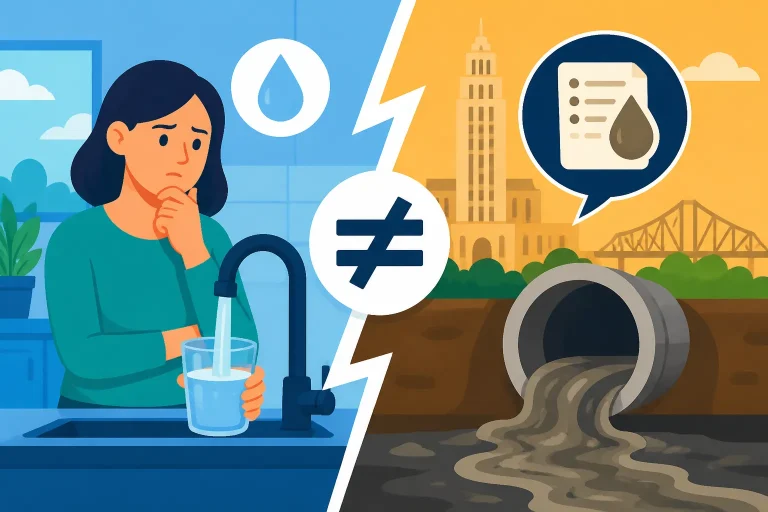
That distinction is important for contaminants such as lead, which can enter water from certain service lines or plumbing materials after the water has left the treatment plant. A utility report can describe system monitoring, but it does not necessarily measure water from every home’s plumbing. Read Does Your City Water Report Reflect Water at Your Own Kitchen Tap? for more on that difference.
For the wider system picture, Louisiana Public Water Systems: Testing, Standards, and Oversight describes how public supplies are monitored and managed. A source that seems clean does not replace treatment and monitoring, and a treatment report does not automatically answer every question about a home’s plumbing.
How to find the source serving your address
The most dependable starting point is the public water system’s annual Consumer Confidence Report, often called a water quality report or CCR. The report typically identifies the system’s water source or source types and summarizes monitoring information. It may describe a river, lake, reservoir or groundwater source, but the report’s exact level of detail varies.
Use the name of the water system serving the property, not only the city or parish name. A city boundary and a water-service boundary are not always the same. A property near a city limit may be served by a different public system, and an apartment or rental home may receive water through a system selected by the property’s location rather than the mailing address.
A practical lookup process
- Check a recent water bill or service account information. Look for the provider or system name. If a landlord or property manager handles the bill, ask which public water system serves the building.
- Find the system’s official website. Search for its annual water quality report or Consumer Confidence Report. If the report is not easy to locate, use the provider’s official contact information to ask where it is posted.
- Confirm that the report matches your service area. Check the system name and any service-area information. If you are unsure whether the provider serves your address, ask the provider directly.
- Read the source-water description. The report may identify a water source, describe a source type or list more than one source. Note the reporting period and read any explanations that accompany the source information.
- Ask whether the system uses additional or alternate sources. Some systems may have more than one source or may change operations. The provider can explain what applies to its service area.
- Treat private wells separately. A public water report does not tell you the test results for a private well. If the property has its own well, ask for well records and arrange appropriate testing through a qualified laboratory or relevant local resource.
The report is useful, but it has boundaries. A CCR summarizes system information and monitoring; it does not usually provide a sample result for every individual tap. It may also describe water that has been treated and distributed, rather than raw water at the river, reservoir or wellhead.
For help understanding the report’s sections and terminology, see Reading a Louisiana Consumer Confidence Report: Key Sections. You can also use Finding Your City’s Annual Water Quality Report in Louisiana to locate the report for the relevant system.
If the report is hard to interpret
A source description may use a technical or regional name. If it is unclear whether the system is using surface water, groundwater or more than one source, ask the provider to explain the terms in the report. Ask whether the listed source is the usual supply, an alternate source, or a source used only under certain conditions.
Keep questions specific. “What source supplies my address?” is more useful than “Is Louisiana water river water?” You might also ask whether the system has multiple sources, whether treatment differs by source, and where the current CCR is available.
A water-quality report is one piece of information. If your concern is a taste or odor change, discolored water, a boil advisory, or possible plumbing contamination, the next step depends on that specific issue. A broad source label cannot diagnose a problem at one home.
What source type can—and cannot—tell you about quality
Knowing the source helps explain what a water system may need to monitor and treat. It does not, by itself, show whether tap water is safe, whether a contaminant is present, or whether a filter is needed.
Source category is not a safety grade
River water is not automatically unsafe because it is exposed to the environment, and groundwater is not automatically safe because it comes from underground. The relevant questions include how the source is treated, how the system is monitored, whether required standards are met and what happens in the distribution network and building plumbing.
A source may also have naturally occurring characteristics that affect taste, odor, staining or scale without telling you whether a health-based standard has been exceeded. Conversely, a contaminant that has no noticeable taste, odor or color cannot be ruled out by appearance. Testing and system monitoring are more useful than assumptions based on source type.
The treatment process matters
A river, lake or aquifer can have different characteristics, but treatment depends on the actual water and the system’s equipment. Two utilities using the same broad source type might operate different treatment processes. A system may also use more than one source or adjust operations as conditions change.
This is why choosing a home filter based only on “river water” or “well water” is a poor shortcut. First identify the concern and the relevant test result, then check whether a treatment product is certified for the specific reduction claim you need. A filter’s claims are not interchangeable, and a product that reduces one contaminant may not reduce another. See Matching Point-of-Use Water Filters to Known Tap Contaminants for a practical way to connect testing and treatment choices.
The report does not necessarily describe your plumbing
A public system’s testing occurs at locations selected under monitoring requirements. Your kitchen faucet is not necessarily one of those locations. Household plumbing, a service line, faucet parts or water that has sat in pipes can affect a sample collected at home.
This is especially relevant for lead. A system can meet its applicable requirements while a particular home still has a plumbing-related concern. If lead is the issue, use information specific to the home’s service line and plumbing, and consider testing at the tap. Lead in Louisiana Tap Water: Service Lines and Health Rules explains the connection between public lines, private plumbing and household sampling.
A change in source is not automatically a problem
A utility may use a different source under certain operating conditions, but a source change alone does not establish that the water is unsafe. Systems are responsible for managing treatment and monitoring in line with their requirements. If a source or treatment change has relevance for customers, check the provider’s official notices and report rather than relying on speculation.
Similarly, flooding, high river levels, drought or a nearby industrial activity does not automatically establish that tap water has been contaminated. The effect depends on the source, system operations and test results. If there is a public notice or advisory, follow the instructions from the responsible water system and public-health authority. For a broad overview of how conditions from source to faucet can matter, see Managing Tap Water Quality From the Raw Source to the Customer Faucet.
Differences for people using private wells
A household private well bypasses the public utility’s treatment and distribution system. The well draws from groundwater, but the owner is responsible for understanding the well’s condition and arranging testing. The aquifer name or the presence of a nearby public water system does not substitute for a test of the household’s own supply.
Private well water can vary with local geology, the well’s depth and construction, and nearby land uses or changes in the well environment. A sample is a snapshot of the water collected at that time; it does not guarantee that results will remain the same indefinitely. Follow testing advice from qualified local or state resources, and retest when circumstances such as flooding, repairs or an unexplained change in taste, odor or appearance raise a concern.
Start with the well’s history and a suitable test
Before choosing treatment, gather whatever information is available about the well: its age, depth, construction, prior test results and any maintenance or disinfection history. If records are incomplete, that is a reason to be careful about assumptions—not a reason to treat the water based on guesswork.
Select testing based on the well and the question you are trying to answer. A basic bacteria test does not check for every chemical, and a broad chemical panel may not answer a question about a sudden bacterial issue. Ask a qualified laboratory or local health resource which tests are appropriate and how to collect the sample. Sample handling matters; incorrect bottles, collection methods or delivery timing can make a result unusable.
For more on choosing and arranging tests, see Drinking Water Testing in Louisiana: When and What to Sample. A positive result or a question about potential health effects should be discussed with the local health department or a medical professional. Do not rely on boiling, odor, clarity or a consumer filter as a substitute for suitable well testing.
Treatment comes after the water question is clear
A treatment system should be selected to address a confirmed water-quality issue or a well-defined goal. Different technologies target different substances. A sediment filter is not the same as a system designed for dissolved contaminants, and a softener is not a universal purifier.
If test results show a concern, check that any proposed system is designed and certified for the specific substance and concentration involved. Follow installation and maintenance requirements, and retest where appropriate to verify performance. For a wider explanation of independent-well responsibilities and options, see Louisiana Private Well Upkeep: Pumps, Casing, and Shocking.
Frequently Asked Questions
Does all Louisiana tap water come from the Mississippi River?
No. Louisiana public water systems may use surface water from rivers, lakes or reservoirs, or groundwater from aquifers. The source depends on the system serving the address.
Is groundwater always safer than river water?
No. Neither source type is automatically safer. Public systems treat and monitor water based on their sources and applicable requirements; private well owners need to arrange appropriate testing for their own water.
Can I tell my water source by its taste or appearance?
Usually not. Taste, odor and appearance do not reliably identify whether water came from a river, reservoir or aquifer. Check the report for the public water system serving your address or ask the provider.
Does a public water report show the result from my kitchen faucet?
Not necessarily. A CCR summarizes information for a water system, but it may not include a sample from your home. Plumbing and service-line materials can affect water after it enters a building.
What should I do if my home uses a private well?
Find any available well records, arrange suitable testing through a qualified laboratory or relevant local resource, and use the results to guide any treatment decisions. A nearby public water report does not describe your well.
Disclaimer
This article is for general informational purposes only and does not constitute professional advice. Laws, prices and regulations vary by location and change over time. Consult a qualified professional for guidance on your specific situation. Louisiana Water Guide is not a government agency or water utility and is not affiliated with any public water system.